60s MGB and MGB GT
MG launched the MGB in 1962 replacing the curvy MGA. The MGB had a new sleek, modern body and a larger engine than the MGA. In its original form with chrome bumpers and grille, the MGB had the restrained and classy look of the 1960s.
The MGA had broken tradition with MG's previous vintage-looking TD and TF models. Its curvaceous body was a bold step for MG. It was, though, beginning to look dated by the early 1960s. Rivals Triumph and Sunbeam both had new cars: the Triumph TR4 and the Sunbeam Alpine. MG's smaller Midget was also more modern and drew customers away from the MGA.
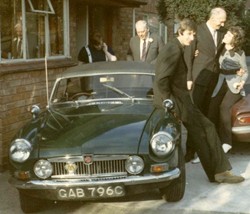
The MGB's new engine was a modified version of the B-series engine used by the MGA. It was now 1800cc with twin carburetors and a high compression ratio. It allowed the MGB to achieve a 0-60mph time of 12.9 seconds and a top speed of over 100mph. In 1962 it was legal to drive at this speed on the new motorways. The MGB was ideal for fast motorway travel, especially on the near empty motorways of the 1960s.
The MGB had leather seats and a new crackle finish black fascia. The new fascia was a distinctive MG feature that was not copied by other manufacturers. In the 1960s sports cars had plain fascias. The walnut treatment being usually reserved for saloons. The MGB also had wind up windows, hardly a luxury today, but not always standard on sports cars of the 1960s. The heater though, was an optional extra on the early Bs. Many customers opted for the wire wheels, retaining some of the vintage sports car appeal. Engineers at MG thought that this option would disappear, with pressed steel wheels being more practical. But MG owners liked wire wheels and they became a feature of 1960s' sports and performance cars. The Jaguar Mk2 also had wire wheels as an option.
Another useful MGB option was the overdrive which worked, at the flick of a switch, on top and third gears. It gave a useful ratio for motorway cruising. Many owners chose the deluxe hood, which folded down behind the passenger compartment. The standard hood was a do-it-yourself affair which you had to take down and put in the boot.
Aftermarket accessories were available for the B, one of the first was a detachable hard top. This was also very soon a factory option. The car pictured above also has driving lamps fitted, the owner has modified the grille to take them. It also has bullet shaped racing mirrors fitted and a wooden sports style steering wheel. The standard steering was large and thin. Another aftermarket accessory was the Paddy Hopkirk pedal extension. It fitted to the accelerator pedal and made heel and toeing easier. [Heel and toe is a performance driving technique.]
The MGB was well liked by the motoring press. It did not have the raw performance of the Triumph TR4, but was a refined and comfortable car with better handling and road holding. Motor tested an early three bearing MGB and found the car a 'delightful modern sports car'. It was capable of 108mph and offered comfortable accommodation for two people with a reasonable amount of luggage. They liked the handling and ride over rough and smooth surfaces and in the wet. The engine provided plenty of torque and pulled well in top from 10mph.
Motoring Which? also liked the MGB. They praised the car's handling and performance. The TR4 had the edge in performance in their tests. But they considered the MGB's combination of performance, handling and comfort was a better package than the TR4.
The Sunbeam Alpine lost out to the MGB on performance and its comfort and ride were no better.
Motoring Which? found minor faults, which included a tendency for the exhaust to cook the passenger's feet and they managed to bend the MGB's steering wheel!
Abingdon had got the compromise right between performance, handling, ride and comfort.
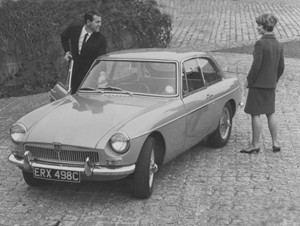
MGB GT
In 1965 the MGB Roadster was joined by a closed fastback style coupe version, the MGB GT. The GT's hatchback style was practical and suited to the British weather. It offered occasional rear seats for small children and a much larger luggage space in the rear.
The MGB GT was styled by Pinninfarina of Italy. The MGB GT's profile was like the Aston Martin DB5. The MGB GT offered saloon style comfort with sporting performance. Although a heavier car than the MGB Roadster, its more aerodynamic profile gave it similar performance figures.
GTs offered a touch of sporting luxury. The MGB GT had similar equipment to the Roadster, but the boot was fully carpeted and the heater was standard. But only the transmission tunnel was carpeted inside the car, the rest of the floor was covered with rubber mats as in the Roadster.
The original brochure talks about the MGB GT as a grand touring car in the spirit of the original definition. The brochure boasted of the MGB GT's ability to cover hundreds of miles without tiring driver or passenger. Experience with owning and driving an original MGB GT suggests that this claim may have been a little exaggerated.
The Motoring press liked the MGB GT just as much as the MGB. Motoring Which? tested the car in 1968 and once again chose it as their best buy beating the Triumph GT6 (there was no official GT version of the TR4) and Sunbeam Alpine GT. In their view it as the only car of the three to approach a true GT car. Motor journalist Michael Bowler had the MGB on long term test and came to the conclusion that it was the car for him. [The actual car is still around see Motor test MGB GT.]
MGB in the 1970s
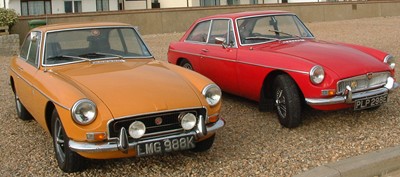
The MGB continued in production right through the 1970s. The last car was made in 1980, when the MG Works at Abingdon closed as part of BL's rationalisation.
For 1971 the MGB had Rostyle wheels, a BL sports style wheel, and a black recessed grille. The colours, such as the orange MGB GT shown on the left, also reflected the changing taste of the early 1970s. Note the style differences between that and the tartan red MGB GT from 1967
The two most significant changes were the introduction of the MGB GT V8 in 1973 and impact absorbing bumpers, introduced in 1974 to meet US safety regulations.
The Rover V8 gave the MGB GT exceptional performance. The lightweight aluminium V8 engine was from the Rover 3.5 Litre (P5b), Rover 3500 (P6), Rover SD1 and Range Rover. The MGB GT had the low compression ratio version of the V8 from the Range Rover. The fully tuned engine could rip the gearbox out. Nevertheless, its sparkling performance delighted MG enthusiasts.
The impact absorbing bumpers met with much less enthusiasm. They were called 'rubber bumpers' and MGBs from then on were divided into chrome bumper and rubber bumper cars. The rubber bumpers gave the MGB a modern look in the late 1970s. But higher suspension did little for the the handling.
1970s' MGBs also benefited from constant updating of the trim. The last models had striped nylon upholstery, a new dashboard and a centre console. By the end of the 1970s, the MGB, although a product of the early 1960s, looked as much a part of the 1970s as a pair of platform shoes. But its performance was well behind contemporary rivals.
MGBs on film
Look out for a MGB in The Ipcress File starring Michael Caine. Major Dolby, Harry Palmer's treasonous boss, has a white MGB roadster. He appears to be the model English gent and the car suited the image well.
MGB FAQ
What does MGB GT stand for?
MG stands for Morris Garages. MG cars were originally sold as special upgrades to Morris cars.
'B' is a model number.
GT stands for 'Gran Turismo'. It means 'Grand Tour' in Italian. In an automoive context it means a comfortable touring car capable of fast speeds. In the 1960s it was often a sports car with a hard top or a tuned-up version of a saloon.
More on the MGB and MGB GT
See Austin Rover online for an excellent history charting the ups and downs of the MGB from 1962 to its final demise in 1980.
There are two clubs serving the MG marque, the MG Owners' Club and the MG Car Club.


Comments