Reflections on the Tricorn
A celebration of the Tricorn Centre, Portsmouth which was demolished in 2004. The Tricorn was designed by the Owen Luder partnership, responsible for the Get Carter Car park in Gateshead. Raw exposed concrete was used in the brutalist style.
So why did we want to save the Tricorn?
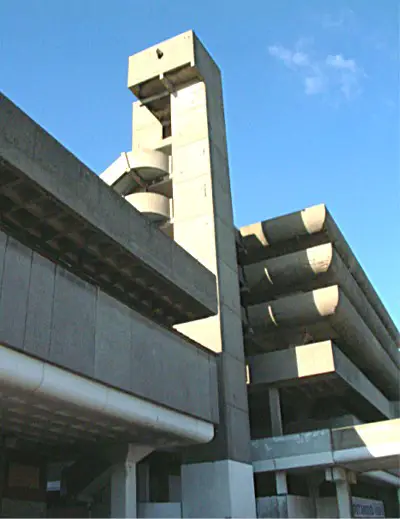
"The Tricorn's not Victorian..."
True enough, the Tricorn was built in 1966, that's sixty-five years after Queen Victoria died - so it would be stretching it a bit to say that the Tricorn was Victorian. But does that mean it's not worth saving? Well the Hoover Building's not Victorian - should we pull that down? I am sure that the thousands of visitors to last year's Art Deco Exhibition at the V & A would disagree.
"But it's an eyesore..."
Back in the 'sixties so were many Victorian buildings - gothic monstrosities - lots of decoration - many black from car fumes. No-one had any time for them, save a bunch of "nutters" called the Victorian Society. Without them we wouldn't have a Victorian building left to preserve.
"So it's a question of taste then?"
Yes. The interesting thing about tastes is that the they change with time. Right now more and more people are interested in the 'sixties - they are buying retro gear, they are driving 'sixties cars and are interested in 'sixties music, writing and art.
"Just like the 'sixties then..."
Well not really. In the 'sixties more and more people were buying Victorian gear for their homes, they were dressing in Victorian military uniforms and they were saving Victorian buildings.
About the Tricorn - original article written before demolition
The Tricorn is a concrete shopping centre and multi-storey car park in Portsmouth. It was a pioneering design for the time, offering shopping, pubs, flats and parking in the same striking concrete building. The Tricorn is a building that provoked strong feelings of both affection and hate. After a couple of years of lying empty it is now being demolished. An attempt to have the building listed to prevent demolition failed. On 11 March 2004, English Heritage announced their decision not to list it.
Portsmouth City Council were so delighted with English Heritage's decision that they turned the demolition into an event with a party atmosphere. A member of the public was chosen by a radio 'phone-in to start the demolition to the cheers of a watching crowd. The demolition began to the strains of the 1812 Overture. Why? Because the Tricorn was once described as symphony in concrete similar to the 1812 overture. The party was accompanied by fireworks. There was no magnanimity in victory here, just a gloating, more suited to the playground.
It is perhaps fitting that the Tricorn should end in this way. Portsmouth wanted a building nationally known. They have one and are destroying it. What will follow? No-one knows. Cutting edge architecture pushing forward the boundaries of taste it will not be - after seeing the crowds baying for the destruction of the Tricorn, who would take the risk? My money is on something bland and inoffensive.
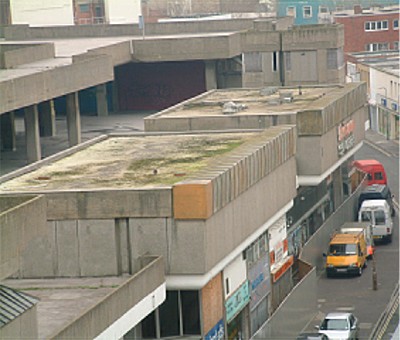
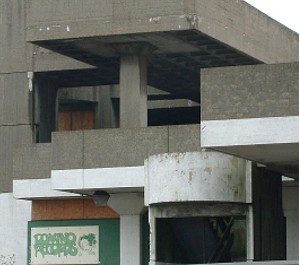
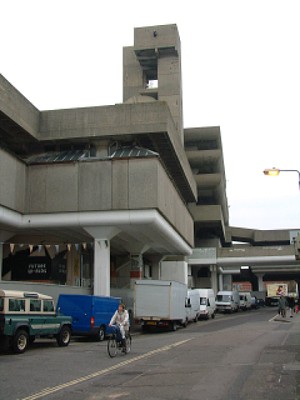
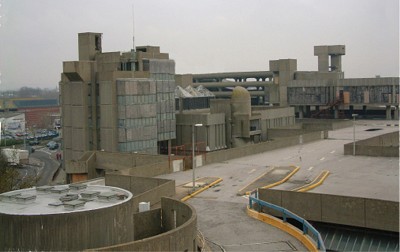
The demolition will take ten months. There is still time to see the Tricorn. This selection of photographs show the Tricorn on a cold, but pleasant February morning in 2004. This is Charlotte Street from the top of the Cascades (left). Is it ugly? Well I do not think so. Judge for yourself. See beyond the neglect and the vandalism. The Tricorn was a great building and could have been again.

Right, spiral entrance to the car park. Some motorists found these challenging!
Tricorn contrasts...
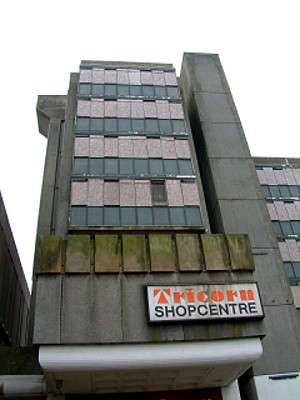
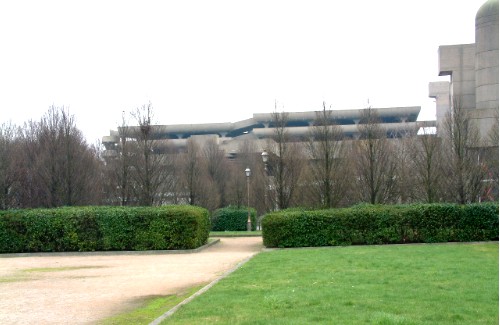
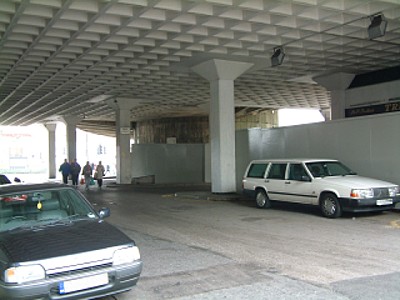
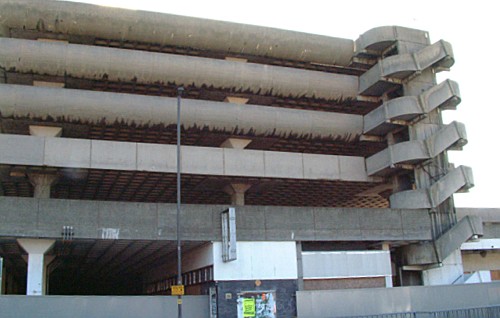
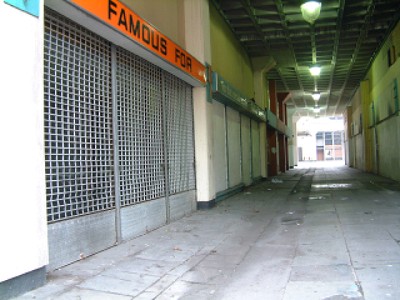
This selection of pictures shows the Tricorn from various different angles. You cannot do justice to a building like this with photographs. You had to see it. Sadly now it has gone.
 |
 |
 |


 |
 |
 |
On the roof:

Original reflections...
- The Tabard Inn - 1875
- The Euston Arch - 1962
- Firestone Factory - 1980
- The Tricorn - 2004
The Tricorn is about to join that distinguished list of buildings destroyed amongst controversy - only to become icons of man's short-sightedness. Just over forty years ago, the Euston Arch, a magnificent classical structure, was needlessly destroyed to make way for a new Euston Station. Needlessly, because it could have been easily moved. In 1980, the magnificent Art Deco Firestone Factory was destroyed. Today there would have been no question of demolition. You could not move for crowds at the recent Art Deco Exhibition at the Victoria and Albert Museum.
Nor is the destruction of important historic buildings a new thing. The first on the list - The Tabard Inn - was featured in both Chaucer's and Shakespeare's works. In spite of public outcry at the time, it was demolished in 1875.
Today, we had a chance not to make the same mistake again with the Tricorn. Porstmouth would have been the better for it. Visitors would have come from outside to see it. They will not come to see just another boring retail development. There were some imaginative and interesting plans to develop the Tricorn in ways that would have given Portsmouth something different and exiting.
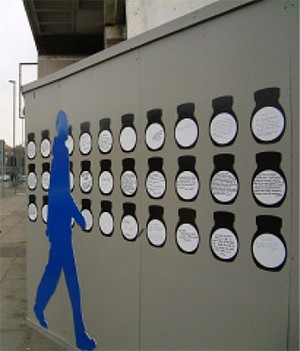
Walking around the Tricorn today, it is a sad building. The public art display around the hoarding showed that the majority had more affection for the Tricorn than dislike.
The Portsmouth Society
Plans for regeneration of the Tricorn and other news about Portsmouthwww.portsmouthsociety.org.uk
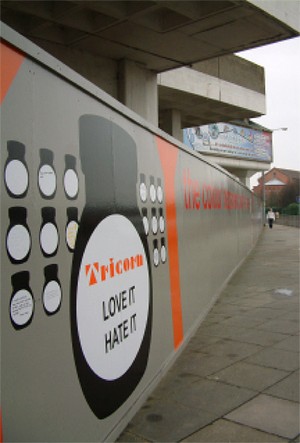
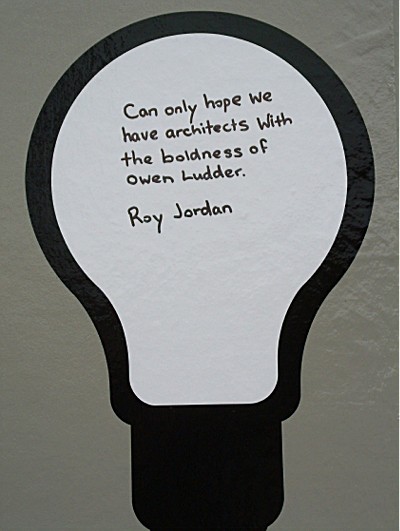
"The Tricorn. Love it. Hate it. The colour happened on the inside" - say the words on the hoardings around the Tricorn. Artist Jeannie Kerswell designed the Public Art Project to give people a chance to express their views about the building. It has helped contribute to the overall debate about the Tricorn's future. It is very important that ordinary people get a chance to say what they think and that the voices heard are not only those from the commercial sector.
 |
 |
 |
Tricorn History
The Tricorn Centre in Portsmouth was designed in 1963 and opened in 1966. The architect of the Tricorn Centre was Rodney Gordon. Rodney Gordon was strongly influenced by the three architectural giants of the twentieth century: Le Corbusier, Mies van der Rohe and Frank Lloyd Wright. Of these he felt that Le Corbusier's exploitation of the sculptural possibilities of concrete offered the best hope for good quality architecture for the masses. By using concrete - which was part of the structure of the building in any case - beautiful buildings could be produced at a cost that was economic. He was a realist, as well as a great architect. This was the main tenant of the philosophy behind Modernism - that form following function and truth to the materials not only made for good design, but that it was good design for everyone - not just the few.
The origins of the design of the Tricorn go back to 1959, when Rodney Gordon first became associated with the Owen Luder Partnership. His first design for Owen Luder was a competition entry for a new shopping centre at Elephant & Castle. Competition on price for this kind of work was very intense in the 'sixties. Many architects of the era used pre-fabricated patterned parts from builders' catalogues to keep costs down. Rodney Gordon felt this led to bad design and poor quality buildings. It also led to buildings looking very bland and the same throughout the country. The approach he took for the Elephant & Castle Shopping Centre was different. It was to have three shopping levels and be accessible from the three different levels. The whole design was to be dominated by a needle-like office block that was to be part of the scheme. Although this project was costed to within the budget, it did not win the competition. The central shopping area or 'Casbah' with access at different levels was to be a key part of Rodney Gordon's future designs.
Rodney Gordon's next design for Owen Luder was built. It was an office block called Eros House at Catford. Here he used "brute" or raw concrete on the exterior for the first time. It incorporated an interesting design of cantilevered floors protruding at different levels and a characteristic separate staircase. The imprint of the shuttering of the concrete was left as the final finish. On the same site a supermarket for Sainsbury's was built. It was given additional form by a shutterboard finished concrete roof that curved upwards. This was a forerunner of the much more extravagant use of concrete at the Tricorn.
The Joy of the Tricorn
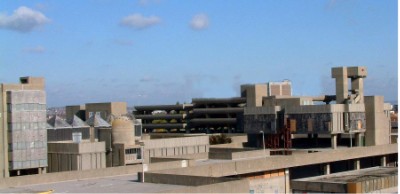
The Tricorn centre was designed as a multi-purpose centre. It was a shopping centre, a covered market and a car park. It also had two pubs and several flats. It was a bold concept for the time and challenged accepted ideas of what a shopping centre was for. It was built on the 'Casbah' principle established in the design of the Elephant & Castle Shopping Centre. The material was concrete and it was used with imagination and thought to create an exciting building. Looking around the Tricorn is fascinating. It is different from every angle and every position. The detail on the finish of the concrete is different. The sculptural forms are exciting - they can be bold - but the detail can be subtle. It is a true Corbusian fantasy in Britain.
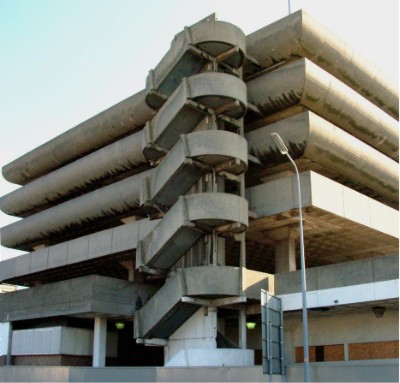
The car park (shown left) has turned up concrete curves - bordering the edges. The staircase external to the building adds to the sculptural effect.
The staircase (below), one of many, shows that concrete can look beautiful.
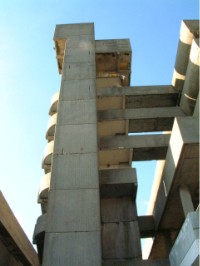

One of the most interesting features of the Tricorn is the spiral entrances and exits to the car park. Some motorists found these challenging! (right)
When it was built, the Tricorn was heralded as an exciting modern building. Ian Nairn, writing in the Guardian in 1967, compared it to the work of the Beatles. We were seeing the beginning of something new. The architecture of 1966 was on the drawing board in 1963. We were seeing the equivalent of the Beatles' early work that sparked seismic change in the music world. He thought the Tricorn would similarly shake up the stuffy world of architecture.
The Tricorn was very much in the spirit of the latter half of the 'sixties. The use of brute concrete as the final finish is very similar to the Whitefriars Glass "Bark" design. The glass was cast in a mould made from real bark, leaving its rough finish on the final product. The design was used for vases, decanters and drinking glasses, which were made in top quality lead crystal - what a contrast to the tired, old designs we normally associate with crystal glassware.
In 1967 the Tricorn won a Civic Trust award for its "exciting visual composition". However, in 1968 it was voted Britain's fourth ugliest building.
The Tragedy of the Tricorn
The Tricorn was always controversial from the start. Hated by the local press, it was never given the chance it deserved. It had only partial success as a shopping centre, even in its heyday. Rodney Gordon thought that the position was wrong. The wrong end of a minor shopping street - yet it is one of the first buildings you see as you drive into Portsmouth. The real reason may have been the imaginative design. It failed to attract the conservative Marks and Spencer. Not all of the shops were let. But, worst of all it was not maintained. It was allowed to decay into the sorry state it is in today.
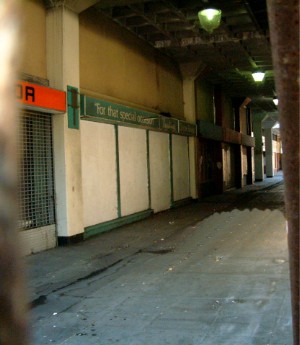
The 'Casbah' design with its many entrances and exits meant that the Tricorn became a haunt for muggers. It was also an easy target for vandals. The result was that the Tricorn became unsafe for families and took on the sinister atmosphere associated with places daubed with graffiti. Now the streets of the Tricorn are closed and boarded up. The tragedy is that the thoughtless few, as always, are allowed to spoil it for the many. Now we design buildings with fewer exits and open spaces which are always watched to make life harder for the criminal. In the 'sixties they were building a better future - one where everyone would be accepted as part of a wider society and crime would be much less of a problem. Sadly it was a problem even then. Vandalism of telephone boxes was costing the Post Office millions as early as the mid 'sixties.
Even in its darkest hours the Tricorn did have some successes. Richard Branson opened his first Virgin Store there. The pubs became night clubs and were popular venues for local bands.
The future for the Tricorn
The Tricorn, as it stands, is not an ideal building for Portsmouth. In spite of its imaginative architecture, the problems with crime and vandalism cannot easily be solved without alteration. There are plans to demolish the site and replace it with a new retail and leisure complex. At the eleventh hour, the original architect, Rodney Gordon, has come up with plans to redevelop the Tricorn that will preserve its best features and will also solve the problems and make it a more usable building. His plans are to retain the main elements of the building - the car park, spiral access ramps, stair towers and flats. He suggests cladding them in a "modern material" such as stainless steel. Personally I think that some of the original character will be lost if this is done - the Tricorn is better in concrete. He also proposes adding more retail space and additional car parking with another spiral ramp. The new proposals will save around 8 million pounds on the cost of development and save the expensive cost of demolishing the huge concrete structure.
Most of the people I have spoken to about the Tricorn have a certain affection for it. It may be that now its future is uncertain they are unwilling to deal the final blow. In the 'seventies the Tricorn did thrive. It had a lively market on Saturdays. Portsmouth now has a choice: destroy the Tricorn and replace it with just another modern retail and leisure complex; or keep it, modernise it and have something exciting and distinctive. People will come to Portsmouth to see the Tricorn - and spend some money there - I did. I know what I would chose - but then I do not live in Portsmouth.
The Tricorn on the Net
There are numerous websites featuring the Tricorn, most have good things to say about it. If you think that it is a great building, you are not alone. If you think it's ugly, look again, you might change your mind. Remember the problems of the Tricorn as it stands could be solved. Portsmouth would have a building to be proud of, something nationally known instead of just another boring retail development.
The Portsmouth Society
Portsmouth Society have been campaigning to save the Tricorn. Visit their web site to see the latest information and a number of alternative plans for its re-use.
www.portsmouthsociety.org.ukMore Tricorn pictures
An excellent set of photos from before that wretched hoarding went up. Check out the interior shots of the spiral entrances to the car park!
www.garfnet.org.uk/picturesBBC Southampton
Have your say on the Tricorn. Some interesting comments posted.
www.bbc.co.uk/southampton/webcams/tricorn.shtml


