The Trimphone
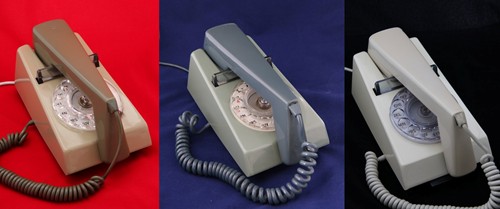
- Production run: 1965 to 1982
- Designer: Martyn Rowlands for STC (Standard Telephones & Cables Ltd)
- Manufacturer: STC and others for the GPO (General Post Office)
- New features: Electronic warbler replaces bell, illuminated dial, new handset, long cable, light weight, compact size
- Cost new: rent from GPO extra 7/6d per quarter
- Value today: £10 to £100 depending on model and condition
The Trimphone was the UK's all new phone for the 1960s. The design was groundbreaking and it changed the way telephones looked and sounded. Out went the traditional bell and in came an electronic warble.
At a time when to have a telephone was a luxury, the Trimphone became a status symbol. However, by the end its life, the Trimphone was regarded as something of a joke. Birds and people imitated the sound of the electronic warbler. Finally, as people found out about its radioactive dial, the Trimphone was branded a public health hazard.
Now it is recognised for the design classic it always was, and the Trimphone is being remanufactured. People are now re-discovering the joy of the electronic warbler.
Brief history
The 1950s was an era when good design ruled. Modern design was revolutionising the look of everything from furniture to cars and from television sets to washing machines, though the telephone remained firmly stuck in the pre-war era and was still made from old fashioned Bakelite.
In 1959 the General Post Office (GPO), Britain's state monopoly provider of telephone services, introduced a modern phone with a contemporary organic look, the 706.
The GPO was not, however, going to be behind the game in the 1960s. At the time of the 706's debut, executives at the GPO were thinking of the next model. They had seen the Bell Princess phone from the USA, which was small, light and had a dial which lit up and thought something similar would work in the UK.
Design
The Council for Industrial Design (COID) had helped the GPO with the development of the 706 and was enlisted again to help select a design for the new phone. A number of manufacturers submitted designs and in 1964 COID chose Martyn Rowlands' design for Standard Telephones and Cables Ltd (STC), the Deltaphone. The GPO placed an initial order for 10,000 units.
The GPO called the new phone the TRIMphone: Tone Ringer Illuminated Model. The Trimphone had a number of features which made it unique:
- Electronic warbler instead of a traditional bell
- Volume control for the ringer
- Illuminated dial
- Light compact design, it weighed only 2lb 5oz instead of 4lb
- New style handset
- Long cable to allow you to move around when on the phone
Around the time of the initial launch the press made much of the new electronic warbler. Customers could also adjust the volume on a telephone ringer for the first time too.
The Trimphone was a very different design. It was neat and modern. The receiver was placed North-South on the phone rather than East-West. The microphone was not where you would expect. STC, who also made the headsets used by telephone operators, used this experience to develop a completely new handset. They put the microphone and earpiece together at the top of the handset, but designed an internal acoustic horn to couple the microphone opening on the handset with the actual microphone. So in spite of popular belief, it was possible to mute the phone by covering what appeared to be the microphone with your hand.
There were three colour schemes, two-tone blue, grey and green or grey and white. The Trimphone was not loud and brash like some sixties products, but more subtle and sophisticated. These phones were more about understated good design than fun and fashion.
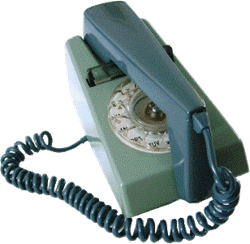
The Deltaphone design won a Council for Industrial Design (COID) award in 1966. Designer Martyn Rowlands made a model of a push-button version as well as a dial version, although the GPO did not introduce the push-button Trimphones until 1977. The COID praised the lightness of the design, which was around half that of existing telephones.
Fiona MacCarthy writing for the Guardian in 1966 thought the Trimphone was designed for obsolescence. History, of course, proved her wrong, but that may have been down to the GPO's monopoly rather than the timelessness of the original design.
Public launch
From design to a phone people could have in their homes took another four years. The design was advanced for the time and engineers found it difficult to get the electronics to work. Perhaps the lack of competitive pressure may not have helped. However, in a competitive telephone market the Trimphone might have been abandoned altogether.
The first Trimphone subscriber
Mr George Byers, an assistant transport official with the Electricity Board and his bride-to-be, Miss Dorothy Freeman, a secretary, received an early wedding present when on 10 May 1965, Mr Anthony Wedgwood Benn, the Postmaster General, presented them with the first Trimphone and the 10 millionth GPO telephone. The ceremony took place at Hampstead Town Hall. The phone was to be installed in the happy couple's new flat in Goldhurst Terrace, Hampstead.
Field trials
From that well publicised presentation there was still a long way to go before any customer could get their hands on a Trimphone.
A limited trial roll-out of the Trimphone began in the London North West Area in November 1965. In Summer 1966, the GPO extended the trial to London North, Northern Ireland and Wales.
The field trials did not go well. In those days shared service or party lines were common. Trimphones in this set up could lead to embarrassment. You could hear your neighbour dialling out and potentially listen in. Also the quality of the microphone in the handset deteriorated quickly and needed replacing. This problem was later solved by an electronic modification of fitting a Regulator 7A across the microphone terminals of the transmission board.
One fault that was never fixed was a direct result of the design brief for a small, light phone; the Trimphone could move about when you dialled. STC developed a low torque dial to fix this issue, but it was never accepted by the GPO.
Available to all
After several field trials, the GPO finally made the Trimphone available to all customers in February 1968. They demonstrated the new phone at the 1968 Daily Mail Ideal Home Exhibition at Olympia, London and signed up many new and eager customers at the event. By June 1968 they had installed 36,000 Trimphones.
As a luxury product, customers had to pay more for the Trimphone. At the time when only around 20% of the population had a phone of any kind, they were not common. Initially you had to pay an extra £1 installation charge and extra rental of 7/6d per quarter. If you already had a phone, the GPO charged 30s to change your existing phone; hardly an incentive to upgrade.
Development
In the age of the pocket calculator, the GPO were characteristically slow to introduce a push-button version of their flagship telephone. Martyn Rowlands' original design had included a push-button version. However, it was not until 1976 that push-button Trimphones finally appeared. Some careful ingenuity was needed, including a slight bending of the PC board to fit it in the case. GEC launched the first of the new models, the 766, in 1976.
In 1979 the GPO introduced an MF (touch tone dialling) model, the 786.
In 1981, the Trimphone range was converted to the new BT Plug and Socket as 8722, 8766 and 8786. Right at the end of its life a number of older phones were given a new skin in colours chosen by Lord Snowdon and new BT style PST connections. They were sold rather than rented to customers and became one of the first phone UK phones you could own.
Status symbol or national joke?
The Trimphone with its extra rental charges was never going to have a huge following and most telephone customers opted for the standard 706 or 746 phones. Perhaps because of this, the Trimphone gained status as a luxury item in the 70s.
The Trimphone was well represented on our television screens. A golden Trimphone was used as a prop on the hugely popular TV show, The Golden Shot, hosted by Bob Monkhouse in 1970. Margot and Jerry Leadbetter, the posh Surbiton couple in The Good Life, naturally had a Trimphone.
In Mike Leigh's parody of middle class life, Abigail's Party, a Trimphone was an important tool for social climbing estate agent, Laurence Moss, along with his van Gogh print, the Complete Works of Shakespeare (not something you'd actually read) and his wife's rotisserie.
By the early 80s the Trimphone was changing from cliché to national joke. Originally engineers carefully tuned the warbler so it was not confused with birdsong. However, starlings quickly learnt to imitate the Trimphone's ring. There were human Trimphone impersonators too. Those tuning into 'That's Life' on Sunday 21 February 1981 were able to enjoy the 'National Final of the boring and ridiculous Trimphone sound-alike competition'.
The Trimphone's wedge shape, associated the design in many peoples' eyes with the 1970s, especially as few people would have seen one in the1960s. In the 1980s the Trimphone was about as fashionable as a pair of flared jeans.
Finally publicity around the use of radioactivity to provide illumination to the Trimphone's dial took its status from national joke to public health hazard and BT caused controversy when they tried to dispose of old Trimphones in the mid 1980s.
Revival
The Trimphone's original design pedigree and contribution to the technological advance of telephones has now been recognised. It is appreciated as a design icon. Especially since the 1970s has been rediscovered.
The ultimate accolade to any product from the past is that you can still buy it new today. The Trimphone is being manufactured by Wild & Wolf, Steepletone and Geemarc.
Resources
See www.britishtelephones.com/t712.htm for more information about the Trimphone.
For more articles about the Trimphone see:
- Wikipedia - the Trimphone
- www.samhallas.co.uk/ - How to disassemble a Trimphone
- phones_1960-80 - Trimphone pictures
By Steven Braggs, April 2012, corrections June 2012, revisions April 2014


Comments