50s technology
The most important single scientific development of the 50s was the transistor. It was invented in Bell Laboratories in the US in 1948, but its potential was not fully realised until the 50s. The pocket transistor radio revolutionised listening to music on the move. Its development ran alongside the growth in popularity of Rock'n'Roll. Developments in electronics also brought benefits to more serious applications, such as computer technology and the space race. The US though, was shocked when the USSR launched Sputnik 1, the first artificial satellite.
The 50s was the age passenger travel by jet plane began. The first commercial jet was Britain's Comet, but early problems meant that this lead was soon lost to Boeing. The 50s was also the era in which the idea of mass travel was pioneered; the first economy class passengers took to the air in the 50s.
Technology in the fifties, in the form of electric and electronic gadgets, began to transform peoples lives. New washing machines, 'fridges and vacuum cleaners meant people had more time to enjoy leisure. Television though, was the marvel that transformed the 50s. Around three quarters of the population had a TV by the end of the fifties and a whole new dimension to life and peoples' conversations began.
Radio
Valve radios
The first advance of the early crystal receivers had been radios using valves or vacuum tubes. Soldiers in the Second World War had to make do with this technology, lugging heavy sets through all sorts of terrain. At the beginning of the fifties, radios sold to the public used valves.
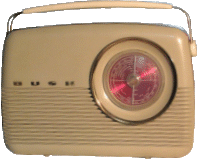
In the 50s, valve radios became smaller and even portable. There were small miniature suitcases and handbags that opened to reveal a radio. Other designs such as the Bush MB60 (left) made use of plastic to give a more stylish design.
Although these sets used miniature valves, they still needed heavy batteries and certainly could not fit into a shirt pocket. The transistor radio was to change all this.
Transistor radios
The first shirt pocket transistor radio was marketed in the US in late 1954 - the Regency TR1. It was not a Japanese import, but a home-grown product manufactured by Texas Instruments, a company that was to become a household name in the world of pocket calculators around twenty years later. However, the American firm's early lead came to nothing in the end when the first Japanese transistor radio sold in the US - the Sony TR 63 was launched in 1957.
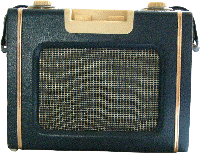
Transistor radios in Britain tended, in the 50s, to be not quite as small as their US or Japanese counterparts. This Every-Ready Sky leader (right) is typical of the era. It dates from around 1958. "Lilliput" the man's magazine chose this radio as a "Counter Attraction" for the July 1958 edition. They described it as suitable for the house, train or car with "big set performance". This radio was quite costly £22 4s 6d - but the performance may well have warranted the extra cost - it was certainly better than most shirt pocket receivers of the era. However it was still quite bulky at 9½ inches by 7½ inches and weighed a whopping 4¾lb.
It was not really until the 60s that the pocket transistor radio really made an impression and became a must-have accessory for every teenager.


